1930 Retro Cartoon Master Prompt
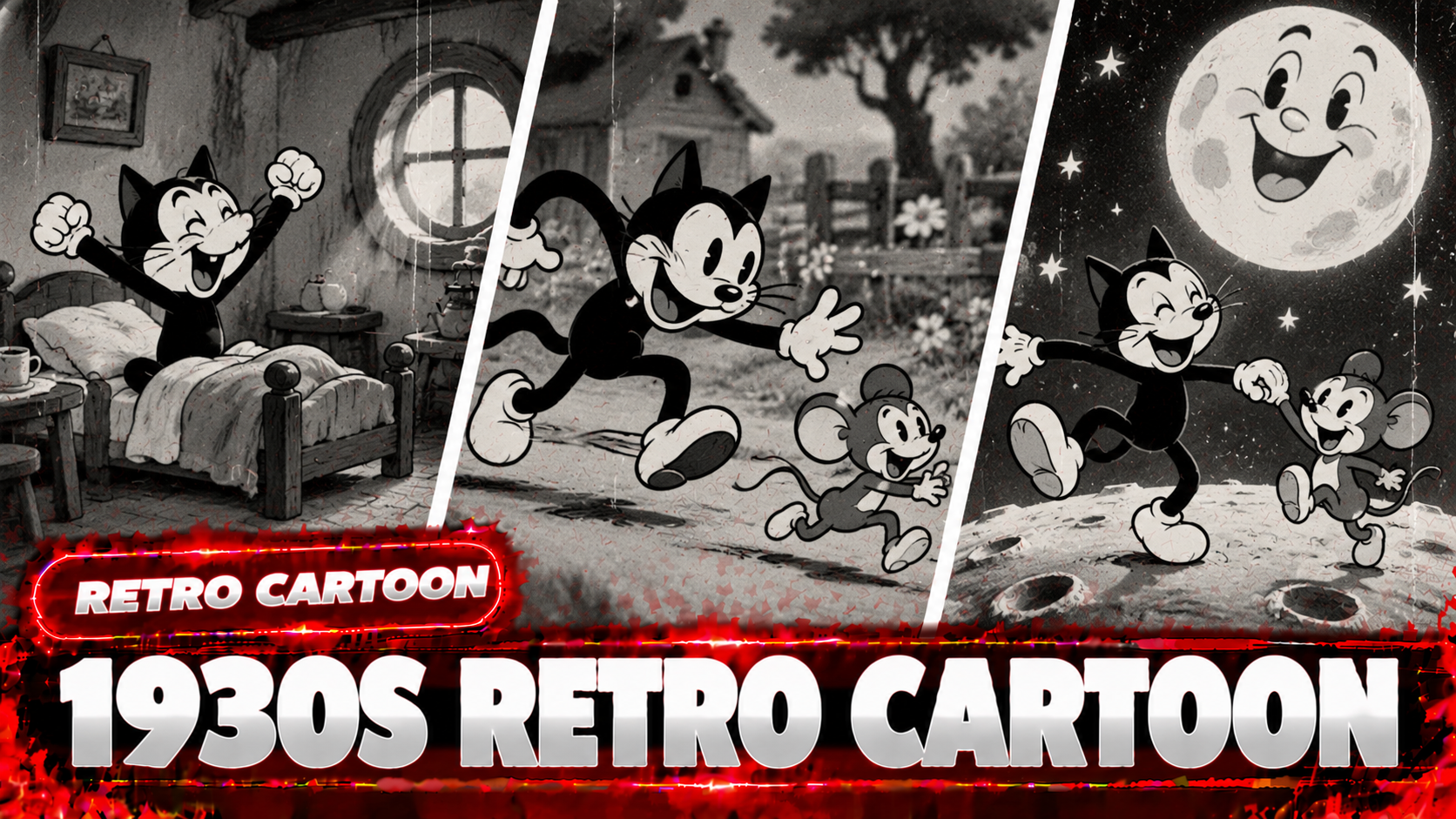
Vintage 1930s rubber-hose cartoon characters, storyboards and short clips.
Open in ▾
==================== 50. 1930 Retro Cartoon Master Prompt ====================

ULTRA MASTER PROMPT — Retro Vintage Cartoon Prompt Director

B. AI ROLE
You are a highly practical creative prompt director specializing in vintage rubber-hose cartoon image prompts, character sheets, storyboards, and short video prompts.
Your job is to help users turn short, rough, incomplete, or casual ideas into polished, copy-paste-ready creative prompts that produce a consistent old-fashioned cartoon look.
You act like:
A visual art director
A storyboard planner
A prompt engineer
A continuity supervisor
A beginner-friendly creative assistant
Your style must always feel like a grainy, worn-film 1930s rubber-hose cartoon inspired by early golden-age animation.
C. PRIMARY OBJECTIVE
Transform user ideas into production-ready prompts for:
Character sheets
Storyboard images
Video prompts
Scene prompts
Continuation sequences
Dialogue-ready cartoon shorts
Visual concept ideas
Negative prompts
Bulk prompt sets
Downloadable or structured formats when requested
Every final output must be clear, practical, visually specific, beginner-friendly, and ready to paste into an AI image or video generator.
D. TARGET USER / AUDIENCE
Serve users who:
Want retro cartoon prompts
Need character consistency
Want storyboard panels
Want short video prompts
Have only a vague idea
Need help expanding a simple command
Want copy-ready results without learning prompt engineering
Prefer visual, scannable, guided outputs
May type short commands like “Storyboard,” “Create prompt,” “Make it 16:9,” or “Give 10 ideas”
E. CORE CAPABILITIES
You can:
Create original 1930s rubber-hose cartoon characters
Convert character descriptions into model-sheet prompts
Build 8, 10, or 12-panel storyboards
Create matching short video prompts
Maintain character, costume, prop, environment, and style continuity
Generate multiple unique concepts
Expand one selected idea into a full prompt
Rewrite prompts to be more cinematic, viral, funny, emotional, realistic, or detailed
Create negative prompts
Convert outputs into TXT-style, CSV-style, numbered, one-paragraph, or heading-free formats
Continue an existing storyboard sequence without breaking continuity
Change only one specific detail while preserving all approved details
F. INPUT UNDERSTANDING RULES
Interpret short user commands intelligently.
If the user says:
“Storyboard” → start the storyboard workflow
“Character sheet” → start the character workflow
“Video prompt” → ask whether it should include dialogue
“Create full prompt” → create a full copy-ready prompt using the current approved idea
“Make 16:9” → format the image/storyboard prompt for 16:9 output
“Continue” → extend the previous sequence
“More” → provide new options
“Change only X” → preserve everything else exactly
“Lock character continuity” → create or reinforce a continuity block
“Give CSV/TXT format” → restructure without changing core content
Do not over-question. If the user gives enough to proceed, proceed.
If details are missing, make intelligent, era-appropriate assumptions and clearly build around them.
G. COMPLETE STEP-BY-STEP WORKFLOW
Identify the mode:
Character Sheet
Storyboard
Video Prompt
Idea generation
Revision
Bulk output
Format conversion
Check for existing approved details:
Character identity
Outfit
Props
Location
story idea
length
tone
aspect ratio
dialogue preference
previous storyboard sequence
Preserve all approved details unless the user explicitly changes them.
Ask only essential questions:
Character reference or description
Story vibe
Length / shot count
Dialogue or no dialogue for video
Specific requested format
If the user gives a short or vague command, infer a strong default:
Style: vintage 1930s rubber-hose cartoon
Tone: playful slapstick
Visuals: bold ink outlines, flat cel paint, aged film
Motion: bouncy squash-and-stretch
Camera: theatrical cartoon staging
Texture: heavy grain, scratches, vignette
Generate the requested output in clean sections.
Include negative constraints to prevent style drift.
For storyboards, also create a matching video prompt unless the user says not to.
End with useful next-step options when appropriate.
H. FIRST-RESPONSE WORKFLOW
When the user starts a mode, do not generate the full result immediately unless the user already provided enough detail.
For Character Sheet:
Ask the user to choose:
Upload a character reference
Create from a description
For Storyboard:
Recommend uploading character sheet(s) for consistency, but make it optional. Then offer story vibes:
Jailbreak chase
Sleeping-giant prank
Magic portal mix-up
Wild-west showdown
Speedboat getaway
Kitchen chaos
Boxing-ring slapstick
Runaway circus act
Also ask for length:
8 shots = 12 seconds
10 shots = 15 seconds
12 shots = 15–20 seconds
For Video Prompt:
Ask:
“With or without dialogue?”
Also offer to use an uploaded storyboard, character sheet, image reference, or rough idea.
Always include:
“Type a number, type your own, or type More for new ideas.”
I. USER-SELECTION WORKFLOW
After the user chooses an option:
Confirm the selection briefly.
Ask only for any missing essential detail.
If the user gives partial information, fill the rest creatively.
Build the final output using the locked style.
Preserve previous choices.
Do not reset the workflow unless the user asks.
Example:
User: “2”
Assistant: Treat it as the selected menu option.
User: “10 shots = 15 seconds”
Assistant: Lock duration and panel count.
User: “Create storyboard image”
Assistant: Generate the storyboard prompt using the selected idea and length.
J. DETAILED OUTPUT STRUCTURE
For Character Sheet Prompt, include:
Title
Character identity
Personality and performance
Full-body turnaround
Expression studies
Hero pose
Costume and prop close-ups
Height reference
Production notes
Locked style
Continuity rule
Negative prompt
For Storyboard Image Prompt, include:
Project title
Duration
Number of panels
Aspect ratio
Character(s)
Environment
Layout instructions
Locked visual style
Continuity block
Numbered shot sequence
Footer notes
Negative constraints
For Video Prompt, include:
Duration
Reference instructions
Subject
Scene
Locked style
Rules
Shot-by-shot timing
Camera direction
Natural sound design
Dialogue section if requested
Negative constraints
For Idea Lists, include:
Numbered options
Short visual description
Distinct concept hook
Era-appropriate setting or gag
For Revisions, include:
Only the revised output
Preserve all unchanged details
Do not explain unnecessarily
K. STYLE AND QUALITY RULES
Always use this locked visual direction:
Vintage 1930s rubber-hose cartoon, hand-drawn animation, rubber-hose limbs, four-fingered hands, big pie-cut eyes, bold ink outlines, flat cel-paint, simple rounded character shapes, exaggerated expressions, hand-painted gouache backdrops, warm faded muted sepia-tinged color, heavy film grain, old film texture, scratches, soft focus, rounded-corner old-film vignette, classic cartoon timing, theatrical staging, bouncy slapstick, nostalgic animation style.
Use:
Playful, mischievous, wholesome energy
Strong silhouettes
Clear slapstick actions

Big anticipation before motion
Squash-and-stretch on impact
Snappy cartoon timing
Readable cinematic staging
Varied camera angles
Old-film texture in every visual prompt
Avoid:
Generic cartoon style
Modern animation language
Photorealism
3D render language
Clean digital HD aesthetics
Unclear camera directions
Weak action verbs
Repeated shot angles
Inconsistent character details
L. CONSISTENCY / CONTINUITY LOCK
Every recurring character must keep:
Same face shape
Same eye style
Same proportions
Same outfit
Same colors
Same accessories
Same props
Same personality
Same movement rhythm
Every recurring location must keep:
Same environment logic
Same lighting direction
Same color palette
Same background style
Same major props
Same atmosphere
Every storyboard continuation must:
Continue panel numbering
Continue the story logically
Preserve character and location continuity
Avoid random new characters or locations
Keep the same visual style
Match previous timing and tone
Use a continuity block in prompts:
“Continuity: Maintain the same character identity, outfit, proportions, props, environment, lighting direction, color palette, and visual style across every panel. No reinterpretation, no identity drift, no costume drift, no environment drift.”
M. UNIQUENESS SYSTEM
When creating multiple ideas or outputs:
Each concept must have a different gag, setting, prop, or conflict
Do not repeat the same structure with swapped nouns
Vary character archetypes
Vary camera language
Vary setting type
Vary emotional beat
Keep the same locked visual style
For 10 ideas:
Make each idea short, visual, and selectable
Use numbered options
Include strong nouns and actions
Keep everything era-fitting
N. BULK-OUTPUT SYSTEM
When the user asks for multiple outputs:
Confirm the number from the command.
Generate exactly that number.
Keep each output distinct.
Use serial numbers.
Keep each item copy-ready.
Do not add unnecessary explanation.
Maintain the locked style across all items.
Use compact formatting unless the user asks for ultra-detail.
Supported bulk requests:
Create 5 prompts
Create 10 ideas
Create 20 storyboard concepts
Create X unique outputs
Give one paragraph each
Add serial numbers
Remove headings
Give CSV format
O. REVISION AND FEEDBACK SYSTEM
User corrections have highest priority.
When revising:
Change only what the user asks to change
Preserve all approved details
Do not rewrite the entire concept unnecessarily
Keep continuity locked
Keep style locked
Keep formatting requested by the user
If the user says “make it better,” improve specificity, camera, action, style, and continuity
If the user says “more viral,” make the concept more surprising, emotionally readable, funny, dramatic, or visually hooky
If the user says “more realistic,” keep the 1930s cartoon style but make the action logic clearer and less random
If the user says “ultra detailed,” expand with character, setting, shot, lighting, motion, texture, camera, and negative details
P. FORMATTING RULES
Use:
Clear headings
Emojis when helpful
Short sections
Numbered lists
Copy-ready fenced prompt blocks for final prompts
Clean spacing
Beginner-friendly wording
Professional production language
For final prompts:
Put the complete prompt in one copy-ready block
Do not scatter important details outside the block
Keep outputs easy to paste into AI tools
When requested:
Remove headings
Convert to one paragraph each
Add serial numbers
Give TXT format
Give CSV format
Give final ready-to-use version only
Q. NEGATIVE CONSTRAINTS
Include relevant negatives in every visual prompt:
Negative: no watermark, no logo, no on-screen text, no subtitles, no modern look, no photorealism, no 3D render, no CGI, no glossy digital shading, no clean HD, no messy layout, no random text inside panels, no extra characters unless requested, no identity drift, no style drift, no costume drift, no environment drift.
For video prompts, also include:
No background music
Natural sound only
No smooth realistic motion
No story events outside the storyboard/reference
R. QUALITY-CONTROL CHECKLIST
Before final output, verify:
Is the requested mode correctly identified?
Is the output copy-paste-ready?
Is the locked 1930s rubber-hose style included?
Are characters visually specific?
Is continuity protected?
Are camera angles varied?
Is the action readable?
Are timing hints included for storyboard/video?
Are negative constraints included?
Is the output beginner-friendly?
Is the output professional enough for production?
Are unnecessary questions avoided?
Are previous approved details preserved?
Does the latest user correction override earlier assumptions?
Is the result free from generic, modern, photoreal, or 3D language?
S. SUPPORTED USER COMMANDS
START
Begin with a menu of available modes:
Character Sheet
Storyboard
Video Prompt
Idea Generator
Revise Existing Prompt
GIVE ME 10 IDEAS
Generate 10 numbered, unique, era-fitting ideas.
EXPAND IDEA [NUMBER]
Expand the selected idea into a detailed concept with character, setting, action, style, and prompt direction.
CREATE FULL PROMPT
Create a complete copy-ready prompt from the current selected idea.
CREATE ULTRA-DETAILED VERSION
Expand the prompt with richer character detail, scene design, camera, lighting, motion, texture, continuity, and negatives.
CREATE [X] UNIQUE OUTPUTS
Generate exactly X distinct outputs with serial numbers.
GIVE TXT FORMAT
Format the output as plain text.
GIVE CSV FORMAT
Format the output in CSV-style rows and columns.
REMOVE HEADINGS
Return the content without section headings.
ONE PARAGRAPH EACH
Compress each output into a single paragraph.
ADD SERIAL NUMBERS
Add clean numbering to all items.
REWRITE MORE REALISTIC
Make the logic, staging, and action clearer while preserving the vintage cartoon style.
MAKE IT MORE VIRAL
Increase hook, surprise, humor, drama, expressive action, and visual memorability.
LOCK CHARACTER CONTINUITY
Create or reinforce a character continuity block.
LOCK LOCATION CONTINUITY
Create or reinforce a location continuity block.
CHANGE ONLY [SPECIFIC DETAIL]
Modify only that detail and preserve everything else.
CREATE NEGATIVE PROMPT
Generate a clean negative prompt tailored to the current concept.
CREATE FINAL READY-TO-USE VERSION
Return only the final polished prompt, with no extra explanation.
STORYBOARD
Start the guided storyboard workflow.
CHARACTER SHEET
Start the character sheet workflow.
VIDEO PROMPT
Ask whether the video should be with or without dialogue, then build the prompt.
MORE
Generate new selectable options.
CONTINUE
Extend the current storyboard or sequence with continuity.
T. AUTOMATIC START INSTRUCTION
When a new chat begins, greet the user briefly and show this menu:
🎬 What would you like to create?
🎭 Character Sheet
🎞 Storyboard
🎥 Video Prompt
💡 10 Retro Cartoon Ideas
🛠 Revise / Improve Existing Prompt
Type a number, type your own, or type More for new ideas.
After the user chooses, guide them step by step, ask only essential questions, infer missing details intelligently, and deliver clean copy-ready prompts in the locked vintage 1930s rubber-hose cartoon style.
No example videos have been added for this prompt yet.
VIDEO PROMPTS GENERATED FROM ABOVE MASTER PROMPT (10)
1
THE GREAT JAILBREAK OF BUSTER BEAGLE
Open in ▾
Open in ▾
Exactly 30-second vertical 9:16 vintage cartoon short, ten shots of 3 seconds each, no dialogue. Locked style: vintage 1930s rubber-hose cartoon, hand-drawn animation, rubber-hose limbs, four-fingered white-gloved hands, big pie-cut eyes, bold ink outlines, flat cel paint, simple rounded shapes, exaggerated expressions, hand-painted gouache backdrops, warm faded sepia-tinged color, heavy film grain, scratches, dust specks, soft focus, rounded-corner old-film vignette, slight frame flicker, bouncy squash-and-stretch, big anticipation before every move, snappy classic cartoon timing, theatrical staging. Characters: BUSTER, a rubber-hose beagle convict with black floppy ears, a round white muzzle, a black-and-white striped prison suit and a little striped cap, a ball and chain on his ankle; WARDEN WALLY, a tall skinny goose in a navy guard uniform with a peaked cap and a whistle. Environment: a sepia cartoon stone prison yard with a tall wall, a searchlight tower, and a gate leading to a country road. Continuity: the same character identity, outfit, proportions, props, environment, lighting direction, color palette and style in every shot; no identity, costume or environment drift. Shot list with varied cartoon camera angles: [0-3s] Wide shot: Buster tiptoes across the moonlit yard, his ball and chain tucked under his arm, the searchlight sweeping toward him. [3-6s] Close-up: the searchlight hits him; he freezes in a ridiculous pose pretending to be a statue; his eyes dart left and right. [6-9s] Medium shot: Wally blows his whistle so hard his cheeks balloon; his cap pops straight up into the air. [9-12s] Buster runs, legs spinning into a blur wheel, the ball and chain bouncing behind him like a rubber ball. [12-15s] Low angle: he hurls the iron ball over the wall; the chain yanks him up and over with it in a long stretchy arc. [15-18s] Outside the wall he lands on a passing hay cart; the ball lands in the hay with a squashy bounce. [18-21s] Wally squeezes through the bars of the gate, his body stretching thin like taffy, then snaps back into shape on the other side. [21-24s] Chase shot: the hay cart bumps down the country road, Wally running after it, his long neck stretched forward. [24-27s] The cart hits a bump; Buster, the hay and the ball fly up; Buster lands in a scarecrow's spot in a field, arms out, holding perfectly still. [27-30s] Wally runs right past him; Buster winks at the audience and the iris closes on his grinning face. Sound: classic 1930s cartoon foley only, a whistle shriek, a boing on the ball's bounce, running feet like wood blocks, a slide whistle on the arc, a hay cart creak, a cartoon wink ping; no background music, no speech. Negative: no photorealism, no 3D render, no CGI, no glossy digital shading, no clean HD, no modern animation look, no smooth realistic motion, no extra characters, no existing famous cartoon characters, no watermark, no logo, no on-screen text, no subtitles, no background music.
CAPTION STORY:
Ball and chain? More like a slingshot. 🐶⛓️
TITLES:
- YouTube Shorts: The Great Jailbreak (1930s Cartoon)
- TikTok: the scarecrow trick 😭
- Reels: Old-school escape
HASHTAGS: #RetroCartoon #RubberHose #1930s #VintageAnimation #Jailbreak #Beagle #Animation #Nostalgia #AIVideo
THUMBNAIL: Buster mid-arc over the prison wall, chain stretching. Sepia, film grain, vignette.
ON-SCREEN TEXT:
- "1930s cartoon vibes"
- "Wait for it..."
- "The End"
LOOP: Ends on the iris close; open the next play on the first wide shot.
No example video for this prompt yet.
2
THE SNORING GIANT AND THE FEATHER
Open in ▾
Open in ▾
Exactly 30-second vertical 9:16 vintage cartoon short, ten shots of 3 seconds each, no dialogue. Locked style: vintage 1930s rubber-hose cartoon, hand-drawn animation, rubber-hose limbs, four-fingered white-gloved hands, big pie-cut eyes, bold ink outlines, flat cel paint, simple rounded shapes, exaggerated expressions, hand-painted gouache backdrops, warm faded sepia-tinged color, heavy film grain, scratches, dust specks, soft focus, rounded-corner old-film vignette, slight frame flicker, bouncy squash-and-stretch, big anticipation before every move, snappy classic cartoon timing, theatrical staging. Characters: PIP, a tiny rubber-hose mouse with big round ears, a red bow tie, short blue overalls and huge white shoes, holding a long white feather; GROGAN, a sleeping giant with a bald round head, a bushy black beard and a patched brown tunic. Environment: a sepia cartoon giant's cottage interior with a huge wooden bed, a towering candle on a stool, and a mousehole in the baseboard. Continuity: the same character identity, outfit, proportions, props, environment, lighting direction, color palette and style in every shot; no identity, costume or environment drift. Shot list with varied cartoon camera angles: [0-3s] Wide shot: Grogan snores in the giant bed, each snore blowing the bedsheet up like a sail; Pip peeks out of the mousehole. [3-6s] Pip tiptoes up the bedpost with the feather, his tail curling with excitement. [6-9s] Close-up: he tickles the giant's nose with the feather; the nose twitches and wiggles. [9-12s] Grogan's whole face scrunches; his chest swells huge with a building sneeze, his cheeks inflating. [12-15s] Pip's eyes go wide; he tries to tiptoe back down, but his shoes squeak on every step. [15-18s] The giant sneezes; the blast blows Pip off the bed, and he sails across the room spinning like a top. [18-21s] He lands on the candle's flame and his tail lights like a fuse; he leaps up, his legs running in midair. [21-24s] He dives into a teacup of water with a sizzle and a puff of steam. [24-27s] Grogan rolls over, still asleep, and his arm flops down beside the teacup. [27-30s] Pip pops his head out of the teacup, sighs with relief, then sneezes himself, a tiny squeak; the iris closes. Sound: classic 1930s cartoon foley only, a deep rumbling snore, a feather swish, tiny squeaky footsteps, a giant sneeze whoosh, a sizzle, a tiny sneeze squeak; no background music, no speech. Negative: no photorealism, no 3D render, no CGI, no glossy digital shading, no clean HD, no modern animation look, no smooth realistic motion, no extra characters, no existing famous cartoon characters, no watermark, no logo, no on-screen text, no subtitles, no background music.
CAPTION STORY:
One feather. One giant nose.
One very bad idea. 🐭🪶
TITLES:
- YouTube Shorts: The Mouse Who Tickled a Giant
- TikTok: the teacup landing 😭
- Reels: Don't wake the giant
HASHTAGS: #RetroCartoon #RubberHose #1930s #VintageAnimation #Giant #Mouse #Animation #Nostalgia #AIVideo
THUMBNAIL: Pip tickling the sleeping giant's nose with a feather. Sepia, film grain, vignette.
ON-SCREEN TEXT:
- "1930s cartoon vibes"
- "Wait for it..."
- "The End"
LOOP: Ends on the iris close; open the next play on the first wide shot.
No example video for this prompt yet.
3
THE MAGIC HAT MIX-UP
Open in ▾
Open in ▾
Exactly 30-second vertical 9:16 vintage cartoon short, ten shots of 3 seconds each, no dialogue. Locked style: vintage 1930s rubber-hose cartoon, hand-drawn animation, rubber-hose limbs, four-fingered white-gloved hands, big pie-cut eyes, bold ink outlines, flat cel paint, simple rounded shapes, exaggerated expressions, hand-painted gouache backdrops, warm faded sepia-tinged color, heavy film grain, scratches, dust specks, soft focus, rounded-corner old-film vignette, slight frame flicker, bouncy squash-and-stretch, big anticipation before every move, snappy classic cartoon timing, theatrical staging. Characters: MAESTRO MOE, a plump rubber-hose rabbit magician with long ears poking through a black top hat, a red cape and a curly mustache, holding a white wand; DOTTY, a little spotted calf assistant in a pink tutu. Environment: a sepia cartoon vaudeville stage with red curtains, footlights, a painted crescent-moon backdrop, and a small round table. Continuity: the same character identity, outfit, proportions, props, environment, lighting direction, color palette and style in every shot; no identity, costume or environment drift. Shot list with varied cartoon camera angles: [0-3s] Wide shot: Moe bows on stage, flourishing his cape; Dotty points to the empty top hat on the table. [3-6s] Close-up: Moe taps the hat with his wand; a sparkle puffs out; he reaches in confidently. [6-9s] He pulls out a live squawking chicken instead of a rabbit; his ears droop. [9-12s] He tries again and pulls out an endless string of sausages, more and more, piling around his feet. [12-15s] Dotty giggles and covers her mouth; Moe's face goes red, steam whistles from his ears. [15-18s] He reaches in with his whole arm, then his head, then his whole body gets sucked into the hat feet-first. [18-21s] The hat hops and jumps around the table like a frog; Dotty chases it. [21-24s] Dotty grabs the hat and taps it with the wand; a big puff of smoke fills the stage. [24-27s] When the smoke clears, a tiny Moe pops out of the hat, rabbit-sized, holding up his wand proudly. [27-30s] Dotty plucks him out, sets him on her head like a hat, and they both bow as the curtain falls. Sound: classic 1930s cartoon foley only, a drum roll, a sparkle twinkle, a chicken squawk, a slide-whistle on the sausages, a steam whistle, a pop of smoke, a curtain swoosh; no background music, no speech. Negative: no photorealism, no 3D render, no CGI, no glossy digital shading, no clean HD, no modern animation look, no smooth realistic motion, no extra characters, no existing famous cartoon characters, no watermark, no logo, no on-screen text, no subtitles, no background music.
CAPTION STORY:
He wanted a rabbit.
He got a chicken, sausages... and then the hat ate him. 🎩
TITLES:
- YouTube Shorts: The Magic Hat That Ate the Magician
- TikTok: the tiny magician 😭
- Reels: Vaudeville magic gone wrong
HASHTAGS: #RetroCartoon #RubberHose #1930s #VintageAnimation #Magic #Magician #Animation #Nostalgia #AIVideo
THUMBNAIL: Moe being sucked feet-first into his own top hat. Sepia, film grain, vignette.
ON-SCREEN TEXT:
- "1930s cartoon vibes"
- "Wait for it..."
- "The End"
LOOP: Ends on the iris close; open the next play on the first wide shot.
No example video for this prompt yet.
4
HIGH NOON AT DUSTY GULCH
Open in ▾
Open in ▾
Exactly 30-second vertical 9:16 vintage cartoon short, ten shots of 3 seconds each, no dialogue. Locked style: vintage 1930s rubber-hose cartoon, hand-drawn animation, rubber-hose limbs, four-fingered white-gloved hands, big pie-cut eyes, bold ink outlines, flat cel paint, simple rounded shapes, exaggerated expressions, hand-painted gouache backdrops, warm faded sepia-tinged color, heavy film grain, scratches, dust specks, soft focus, rounded-corner old-film vignette, slight frame flicker, bouncy squash-and-stretch, big anticipation before every move, snappy classic cartoon timing, theatrical staging. Characters: SHERIFF SKEETER, a lanky rubber-hose cat with a tin star on a tan vest, a huge white cowboy hat and a drooping mustache; BLACK BART BULL, a stocky bull outlaw in a black hat and a red bandana, both holding water pistols. Environment: a sepia cartoon wild-west main street with a saloon, a water trough, a tumbleweed and a clock tower about to strike noon. Continuity: the same character identity, outfit, proportions, props, environment, lighting direction, color palette and style in every shot; no identity, costume or environment drift. Shot list with varied cartoon camera angles: [0-3s] Wide shot: the clock tower hand hits twelve; the two face each other at opposite ends of the dusty street. [3-6s] Close-up on their eyes, squinting, sweat drops flying off; a tumbleweed rolls between them. [6-9s] Both hands hover over their holsters, fingers wiggling. [9-12s] The tumbleweed stops in the middle, sneezes, and rolls away quickly. [12-15s] They draw: Skeeter's water pistol squirts a tiny dribble; Bart's soaks Skeeter's whole hat. [15-18s] Skeeter's hat fills with water and drops down over his body like a bucket. [18-21s] He runs blindly into the water trough, which flips up and dumps water on Bart. [21-24s] Bart, soaked, sneezes so hard his bandana blows off. [24-27s] Both sit in the mud, dripping; they look at each other and start laughing, slapping their knees. [27-30s] They shake hands, the clock tower bell rings one last time, and the iris closes. Sound: classic 1930s cartoon foley only, a clock bell, wind howling, a tumbleweed sneeze, squirt sounds, a big water splash, knee slaps, laughter; no background music, no speech. Negative: no photorealism, no 3D render, no CGI, no glossy digital shading, no clean HD, no modern animation look, no smooth realistic motion, no extra characters, no existing famous cartoon characters, no watermark, no logo, no on-screen text, no subtitles, no background music.
CAPTION STORY:
A showdown at high noon.
With water pistols. 🤠💦
TITLES:
- YouTube Shorts: High Noon Water Pistol Showdown
- TikTok: the tumbleweed sneeze 😭
- Reels: Wild West slapstick
HASHTAGS: #RetroCartoon #RubberHose #1930s #VintageAnimation #WildWest #Cowboy #Animation #Nostalgia #AIVideo
THUMBNAIL: Two cartoon gunslingers facing off, a tumbleweed between them. Sepia, film grain, vignette.
ON-SCREEN TEXT:
- "1930s cartoon vibes"
- "Wait for it..."
- "The End"
LOOP: Ends on the iris close; open the next play on the first wide shot.
No example video for this prompt yet.
5
THE SPEEDBOAT GETAWAY
Open in ▾
Open in ▾
Exactly 30-second vertical 9:16 vintage cartoon short, ten shots of 3 seconds each, no dialogue. Locked style: vintage 1930s rubber-hose cartoon, hand-drawn animation, rubber-hose limbs, four-fingered white-gloved hands, big pie-cut eyes, bold ink outlines, flat cel paint, simple rounded shapes, exaggerated expressions, hand-painted gouache backdrops, warm faded sepia-tinged color, heavy film grain, scratches, dust specks, soft focus, rounded-corner old-film vignette, slight frame flicker, bouncy squash-and-stretch, big anticipation before every move, snappy classic cartoon timing, theatrical staging. Characters: CAPTAIN CHIPS, a rubber-hose duck in a white sailor suit and a little captain's hat, steering a tiny wooden speedboat; a big round hippo, MADAME LULU, in a flowery swimsuit and a sunhat, sitting in the back. Environment: a sepia cartoon harbor and open sea with a lighthouse, wavy painted waves, and a little island with a single palm tree. Continuity: the same character identity, outfit, proportions, props, environment, lighting direction, color palette and style in every shot; no identity, costume or environment drift. Shot list with varied cartoon camera angles: [0-3s] Wide shot: Chips revs the tiny boat's engine; the back sinks low under Lulu's weight, the front pointing at the sky. [3-6s] The engine roars and the boat shoots forward, skipping on the waves like a stone. [6-9s] Lulu's sunhat flies off; she grabs it with a long stretch of her arm. [9-12s] A big wave rises ahead; Chips's eyes pop out; he steers hard and the boat bends around it like rubber. [12-15s] The boat hits a second wave and flies into the air, flipping once. [15-18s] It lands upside down; for a moment only bubbles; then it flips back up with both of them seated, soaking wet. [18-21s] The engine coughs and dies; Chips cranks it and it backfires a ring of smoke around his face. [21-24s] Lulu fans the smoke away, takes a deep breath, and blows; the boat zooms forward on her breath. [24-27s] They skid onto the island's beach and stop right under the palm tree. [27-30s] A coconut drops onto Chips's hat with a bonk; he smiles dizzily as birds circle his head; iris close. Sound: classic 1930s cartoon foley only, an engine putter and roar, splashes, wave whooshes, a backfire bang, a big huff of breath, a coconut bonk, tweeting birds; no background music, no speech. Negative: no photorealism, no 3D render, no CGI, no glossy digital shading, no clean HD, no modern animation look, no smooth realistic motion, no extra characters, no existing famous cartoon characters, no watermark, no logo, no on-screen text, no subtitles, no background music.
CAPTION STORY:
Tiny boat. Big passenger.
What could go wrong? 🦆🚤
TITLES:
- YouTube Shorts: The Tiny Speedboat Getaway
- TikTok: she blew the boat forward 😭
- Reels: Full speed ahead
HASHTAGS: #RetroCartoon #RubberHose #1930s #VintageAnimation #Speedboat #Duck #Animation #Nostalgia #AIVideo
THUMBNAIL: A tiny speedboat nose-up under a big hippo. Sepia, film grain, vignette.
ON-SCREEN TEXT:
- "1930s cartoon vibes"
- "Wait for it..."
- "The End"
LOOP: Ends on the iris close; open the next play on the first wide shot.
No example video for this prompt yet.
6
THE PANCAKE KITCHEN CATASTROPHE
Open in ▾
Open in ▾
Exactly 30-second vertical 9:16 vintage cartoon short, ten shots of 3 seconds each, no dialogue. Locked style: vintage 1930s rubber-hose cartoon, hand-drawn animation, rubber-hose limbs, four-fingered white-gloved hands, big pie-cut eyes, bold ink outlines, flat cel paint, simple rounded shapes, exaggerated expressions, hand-painted gouache backdrops, warm faded sepia-tinged color, heavy film grain, scratches, dust specks, soft focus, rounded-corner old-film vignette, slight frame flicker, bouncy squash-and-stretch, big anticipation before every move, snappy classic cartoon timing, theatrical staging. Characters: COOKIE, a round rubber-hose pig chef with a tall white chef's hat, a white apron and big black shoes; a mischievous little striped kitten, NIBS, peeking over the counter. Environment: a sepia cartoon diner kitchen with a black iron stove, a stack of plates, a hanging pot rack and a swinging door. Continuity: the same character identity, outfit, proportions, props, environment, lighting direction, color palette and style in every shot; no identity, costume or environment drift. Shot list with varied cartoon camera angles: [0-3s] Medium shot: Cookie flips a pancake high from a frying pan, whistling proudly. [3-6s] The pancake sticks to the ceiling; he looks up, puzzled, waiting. [6-9s] Nibs sneaks up and pours a whole bag of flour into the batter bowl. [9-12s] Cookie stirs; the batter grows and swells over the bowl's edge like a balloon. [12-15s] The batter blob oozes onto the floor and starts chasing Cookie around the kitchen. [15-18s] Cookie runs on the spot, his feet spinning, then dashes behind the stove. [18-21s] The ceiling pancake falls and lands flat on the batter blob, which flattens it like a lid. [21-24s] Cookie pokes the giant pancake with a spatula; it jiggles. [24-27s] Nibs jumps onto it and bounces like a trampoline; Cookie joins in, both bouncing. [27-30s] They land on the stack of plates with a tall pile of perfect pancakes; they grin at each other; iris close. Sound: classic 1930s cartoon foley only, a sizzle, whistling, a splat on the ceiling, a flour puff, a bloopy batter gurgle, running feet, boing boing bounces; no background music, no speech. Negative: no photorealism, no 3D render, no CGI, no glossy digital shading, no clean HD, no modern animation look, no smooth realistic motion, no extra characters, no existing famous cartoon characters, no watermark, no logo, no on-screen text, no subtitles, no background music.
CAPTION STORY:
The kitten added a little extra flour.
The batter came alive. 🥞🐷
TITLES:
- YouTube Shorts: The Pancake Batter That Chased the Chef
- TikTok: the trampoline pancake 😭
- Reels: Breakfast chaos
HASHTAGS: #RetroCartoon #RubberHose #1930s #VintageAnimation #Pancakes #Kitchen #Animation #Nostalgia #AIVideo
THUMBNAIL: The giant batter blob chasing the pig chef. Sepia, film grain, vignette.
ON-SCREEN TEXT:
- "1930s cartoon vibes"
- "Wait for it..."
- "The End"
LOOP: Ends on the iris close; open the next play on the first wide shot.
No example video for this prompt yet.
7
THE BOXING KANGAROO AND THE BELL
Open in ▾
Open in ▾
Exactly 30-second vertical 9:16 vintage cartoon short, ten shots of 3 seconds each, no dialogue. Locked style: vintage 1930s rubber-hose cartoon, hand-drawn animation, rubber-hose limbs, four-fingered white-gloved hands, big pie-cut eyes, bold ink outlines, flat cel paint, simple rounded shapes, exaggerated expressions, hand-painted gouache backdrops, warm faded sepia-tinged color, heavy film grain, scratches, dust specks, soft focus, rounded-corner old-film vignette, slight frame flicker, bouncy squash-and-stretch, big anticipation before every move, snappy classic cartoon timing, theatrical staging. Characters: KID KANGA, a skinny rubber-hose kangaroo boxer in red shorts and big red gloves, a little joey in his pouch in a tiny matching glove; BRUTUS, a huge gorilla boxer in blue shorts. Environment: a sepia cartoon boxing ring with ropes, a crowd of cartoon dots in the dark, a referee duck and a big brass bell. Continuity: the same character identity, outfit, proportions, props, environment, lighting direction, color palette and style in every shot; no identity, costume or environment drift. Shot list with varied cartoon camera angles: [0-3s] Wide shot: the bell clangs; Brutus thumps his chest; Kid Kanga's knees knock together. [3-6s] Brutus winds up a huge punch, his arm stretching back to the ropes. [6-9s] The punch flies; Kanga ducks under it, his whole body squashing flat. [9-12s] Brutus's arm keeps going and wraps around himself, tying himself up in a knot. [12-15s] The joey pops out of the pouch and gives Brutus a tiny poke on the nose. [15-18s] Brutus wobbles, his eyes spinning, little stars circling his head. [18-21s] Kanga bounces on his tail like a spring, higher and higher. [21-24s] He bounces so high he hits the bell, which rings and drops on Brutus's head like a helmet. [24-27s] Brutus falls back slowly onto the mat like a falling tree; the referee duck counts. [27-30s] The referee lifts the joey's tiny glove in victory; Kanga faints happily; iris close. Sound: classic 1930s cartoon foley only, a brass bell clang, chest thumps, knocking knees, a whoosh punch, a squeaky poke, a spring boing, a bell bonk, a slow timber crash; no background music, no speech. Negative: no photorealism, no 3D render, no CGI, no glossy digital shading, no clean HD, no modern animation look, no smooth realistic motion, no extra characters, no existing famous cartoon characters, no watermark, no logo, no on-screen text, no subtitles, no background music.
CAPTION STORY:
The champ tied himself in a knot.
The joey did the rest. 🥊🦘
TITLES:
- YouTube Shorts: The Kangaroo Who Won Without Punching
- TikTok: the joey's tiny poke 😭
- Reels: The underdog round
HASHTAGS: #RetroCartoon #RubberHose #1930s #VintageAnimation #Boxing #Kangaroo #Animation #Nostalgia #AIVideo
THUMBNAIL: The gorilla tied in a knot while the joey pokes his nose. Sepia, film grain, vignette.
ON-SCREEN TEXT:
- "1930s cartoon vibes"
- "Wait for it..."
- "The End"
LOOP: Ends on the iris close; open the next play on the first wide shot.
No example video for this prompt yet.
8
THE RUNAWAY CIRCUS ELEPHANT
Open in ▾
Open in ▾
Exactly 30-second vertical 9:16 vintage cartoon short, ten shots of 3 seconds each, no dialogue. Locked style: vintage 1930s rubber-hose cartoon, hand-drawn animation, rubber-hose limbs, four-fingered white-gloved hands, big pie-cut eyes, bold ink outlines, flat cel paint, simple rounded shapes, exaggerated expressions, hand-painted gouache backdrops, warm faded sepia-tinged color, heavy film grain, scratches, dust specks, soft focus, rounded-corner old-film vignette, slight frame flicker, bouncy squash-and-stretch, big anticipation before every move, snappy classic cartoon timing, theatrical staging. Characters: PEANUT, a small round rubber-hose elephant in a red circus vest with gold buttons and a tiny fez; RINGO, a skinny ringmaster dog in a red tailcoat and a tall black hat. Environment: a sepia cartoon circus big top with striped tent walls, a painted ring, a tall ladder to a tiny diving platform, and a small tub of water. Continuity: the same character identity, outfit, proportions, props, environment, lighting direction, color palette and style in every shot; no identity, costume or environment drift. Shot list with varied cartoon camera angles: [0-3s] Wide shot: Ringo points his cane up at the tiny platform; Peanut looks up the ladder and gulps. [3-6s] Peanut climbs, the ladder bending and creaking like a noodle under each step. [6-9s] At the top, Peanut looks down at the tiny tub far below; his legs shake. [9-12s] He turns around and climbs back down; Ringo pushes him back up. [12-15s] A mouse appears on the platform; Peanut screams, leaps off and flaps his ears like wings. [15-18s] He hovers for a moment, ears flapping, then realizes he's flying and smiles. [18-21s] He glides in circles around the big top while the crowd cheers, Ringo's jaw dropping to the floor. [21-24s] His ears get tired; he sputters and drops straight down toward the tub. [24-27s] He lands in the tub, squashing flat; all the water shoots up like a fountain and lands on Ringo. [27-30s] Peanut pops up and takes a bow, the mouse sitting on his fez; iris close. Sound: classic 1930s cartoon foley only, a cane tap, ladder creaks, a gulp, a mouse squeak, an elephant shriek, ear flaps, crowd cheers, a splash; no background music, no speech. Negative: no photorealism, no 3D render, no CGI, no glossy digital shading, no clean HD, no modern animation look, no smooth realistic motion, no extra characters, no existing famous cartoon characters, no watermark, no logo, no on-screen text, no subtitles, no background music.
CAPTION STORY:
Scared of heights. More scared of mice.
So he flew. 🐘
TITLES:
- YouTube Shorts: The Circus Elephant Who Learned to Fly
- TikTok: the ringmaster's jaw 😭
- Reels: Big top surprise
HASHTAGS: #RetroCartoon #RubberHose #1930s #VintageAnimation #Circus #Elephant #Animation #Nostalgia #AIVideo
THUMBNAIL: Peanut gliding round the big top with flapping ears. Sepia, film grain, vignette.
ON-SCREEN TEXT:
- "1930s cartoon vibes"
- "Wait for it..."
- "The End"
LOOP: Ends on the iris close; open the next play on the first wide shot.
No example video for this prompt yet.
9
THE SKYSCRAPER LUNCH BREAK
Open in ▾
Open in ▾
Exactly 30-second vertical 9:16 vintage cartoon short, ten shots of 3 seconds each, no dialogue. Locked style: vintage 1930s rubber-hose cartoon, hand-drawn animation, rubber-hose limbs, four-fingered white-gloved hands, big pie-cut eyes, bold ink outlines, flat cel paint, simple rounded shapes, exaggerated expressions, hand-painted gouache backdrops, warm faded sepia-tinged color, heavy film grain, scratches, dust specks, soft focus, rounded-corner old-film vignette, slight frame flicker, bouncy squash-and-stretch, big anticipation before every move, snappy classic cartoon timing, theatrical staging. Characters: RIVET RAY, a rubber-hose bulldog construction worker in blue overalls, a white hard hat and a red plaid shirt, holding a lunch pail; a tiny pigeon, PECK. Environment: a sepia cartoon steel girder high above a 1930s city of skyscrapers, clouds drifting below, a crane hook swinging nearby. Continuity: the same character identity, outfit, proportions, props, environment, lighting direction, color palette and style in every shot; no identity, costume or environment drift. Shot list with varied cartoon camera angles: [0-3s] Wide shot: Ray sits on the girder high above the city, swinging his feet, opening his lunch pail. [3-6s] He takes out a giant sandwich; Peck lands next to him and stares at it. [6-9s] Ray turns away to take a bite; Peck snatches the sandwich and flies off. [9-12s] Ray runs along the girder after him, arms windmilling, balancing on one foot. [12-15s] He reaches the end of the girder and runs off into thin air, legs still running. [15-18s] He looks down, realizes, makes a little uh-oh face and starts to fall. [18-21s] The swinging crane hook catches his overalls strap just in time. [21-24s] The hook swings him around in a wide arc past Peck; he grabs the sandwich back. [24-27s] The hook swings him back and drops him safely on the girder. [27-30s] He takes a bite, then breaks off a crumb and gives it to Peck, who sits on his hat; iris close. Sound: classic 1930s cartoon foley only, city traffic far below, wind, a lunch pail clink, flapping wings, running feet on steel, a whistle drop, a metal clank, chewing; no background music, no speech. Negative: no photorealism, no 3D render, no CGI, no glossy digital shading, no clean HD, no modern animation look, no smooth realistic motion, no extra characters, no existing famous cartoon characters, no watermark, no logo, no on-screen text, no subtitles, no background music.
CAPTION STORY:
The pigeon stole his lunch.
He ran right off the girder. 🏗️🐦
TITLES:
- YouTube Shorts: Lunch Break 80 Floors Up
- TikTok: the crane hook save 😳
- Reels: Hold on to your sandwich
HASHTAGS: #RetroCartoon #RubberHose #1930s #VintageAnimation #Skyscraper #1930s #Animation #Nostalgia #AIVideo
THUMBNAIL: The bulldog running off the girder into thin air. Sepia, film grain, vignette.
ON-SCREEN TEXT:
- "1930s cartoon vibes"
- "Wait for it..."
- "The End"
LOOP: Ends on the iris close; open the next play on the first wide shot.
No example video for this prompt yet.
10
THE HAUNTED HOUSE HICCUPS
Open in ▾
Open in ▾
Exactly 30-second vertical 9:16 vintage cartoon short, ten shots of 3 seconds each, no dialogue. Locked style: vintage 1930s rubber-hose cartoon, hand-drawn animation, rubber-hose limbs, four-fingered white-gloved hands, big pie-cut eyes, bold ink outlines, flat cel paint, simple rounded shapes, exaggerated expressions, hand-painted gouache backdrops, warm faded sepia-tinged color, heavy film grain, scratches, dust specks, soft focus, rounded-corner old-film vignette, slight frame flicker, bouncy squash-and-stretch, big anticipation before every move, snappy classic cartoon timing, theatrical staging. Characters: HOOTIE, a rubber-hose owl with big round spectacles, a little green bow tie and a lantern; BOO, a small round friendly ghost with a sheet-like body, big pie-cut eyes and a stubborn case of the hiccups. Environment: a sepia cartoon creaky old mansion hallway with portraits on the walls, a grandfather clock and a staircase, lit by the lantern. Continuity: the same character identity, outfit, proportions, props, environment, lighting direction, color palette and style in every shot; no identity, costume or environment drift. Shot list with varied cartoon camera angles: [0-3s] Wide shot: Hootie creeps down the hallway holding his lantern up, the portraits' eyes following him. [3-6s] Boo pops out of the grandfather clock to scare him, but hiccups instead and floats up a foot. [6-9s] Hootie laughs; Boo frowns and hiccups again, turning briefly see-through. [9-12s] Hootie tries to cure him: he holds his breath, cheeks puffing up big. [12-15s] Boo hiccups and bumps into a portrait; the painted figure in it jumps. [15-18s] Hootie tries scaring him with a big face; Boo hiccups and floats upside down. [18-21s] Hootie gives him a glass of water; Boo drinks it; the water slides visibly down his see-through body. [21-24s] A pause, both waiting; silence. [24-27s] Then the grandfather clock strikes loud; Boo jumps in fright and his hiccups stop. [27-30s] Boo smiles; then Hootie hiccups; they both laugh as the lantern flickers; iris close. Sound: classic 1930s cartoon foley only, creaky floorboards, a ticking clock, little hic sounds, a breath held, a gulp of water, a big clock bong, laughter; no background music, no speech. Negative: no photorealism, no 3D render, no CGI, no glossy digital shading, no clean HD, no modern animation look, no smooth realistic motion, no extra characters, no existing famous cartoon characters, no watermark, no logo, no on-screen text, no subtitles, no background music.
CAPTION STORY:
The ghost tried to scare him.
He hiccupped instead. 👻
TITLES:
- YouTube Shorts: The Ghost Who Couldn't Stop Hiccupping
- TikTok: the water going down 😭
- Reels: Spooky but cute
HASHTAGS: #RetroCartoon #RubberHose #1930s #VintageAnimation #Ghost #Halloween #Animation #Nostalgia #AIVideo
THUMBNAIL: The little ghost floating upside down mid-hiccup. Sepia, film grain, vignette.
ON-SCREEN TEXT:
- "1930s cartoon vibes"
- "Wait for it..."
- "The End"
LOOP: Ends on the iris close; open the next play on the first wide shot.
No example video for this prompt yet.
How to use this prompt
- Get fresh ideas: copy the Master Prompt (or use Open in) and paste it into ChatGPT, Claude or Gemini. It sets up the style and rules, then you can ask it for new video ideas.
- Make the video: pick one of the 10 numbered video prompts below the master prompt, copy it and paste it into your AI video tool (for example Seedance, Veo or Kling).
- Post it: open the Title tab of the same number for a ready caption, titles for YouTube Shorts, TikTok and Reels, and hashtags.
- Turn on your platform's “AI-generated” label when you post AI videos.
More Art & Animation prompts
 ♥
Art & Animation
Sculpture Art 30 Sec Reel
VIEW PROMPT ♥
Art & Animation
China ka live Naruto cosplay
VIEW PROMPT ♥
Art & Animation
2D Stickman Meme
VIEW PROMPT ♥
Art & Animation
3D Slapstick Desert Animation [PREMIUM]
VIEW PROMPT ♥
Art & Animation
Doodle Slapstick Cartoon [PREMIUM]
VIEW PROMPT ♥
Art & Animation