Viral Painted Wood Scroll-Saw Cutting
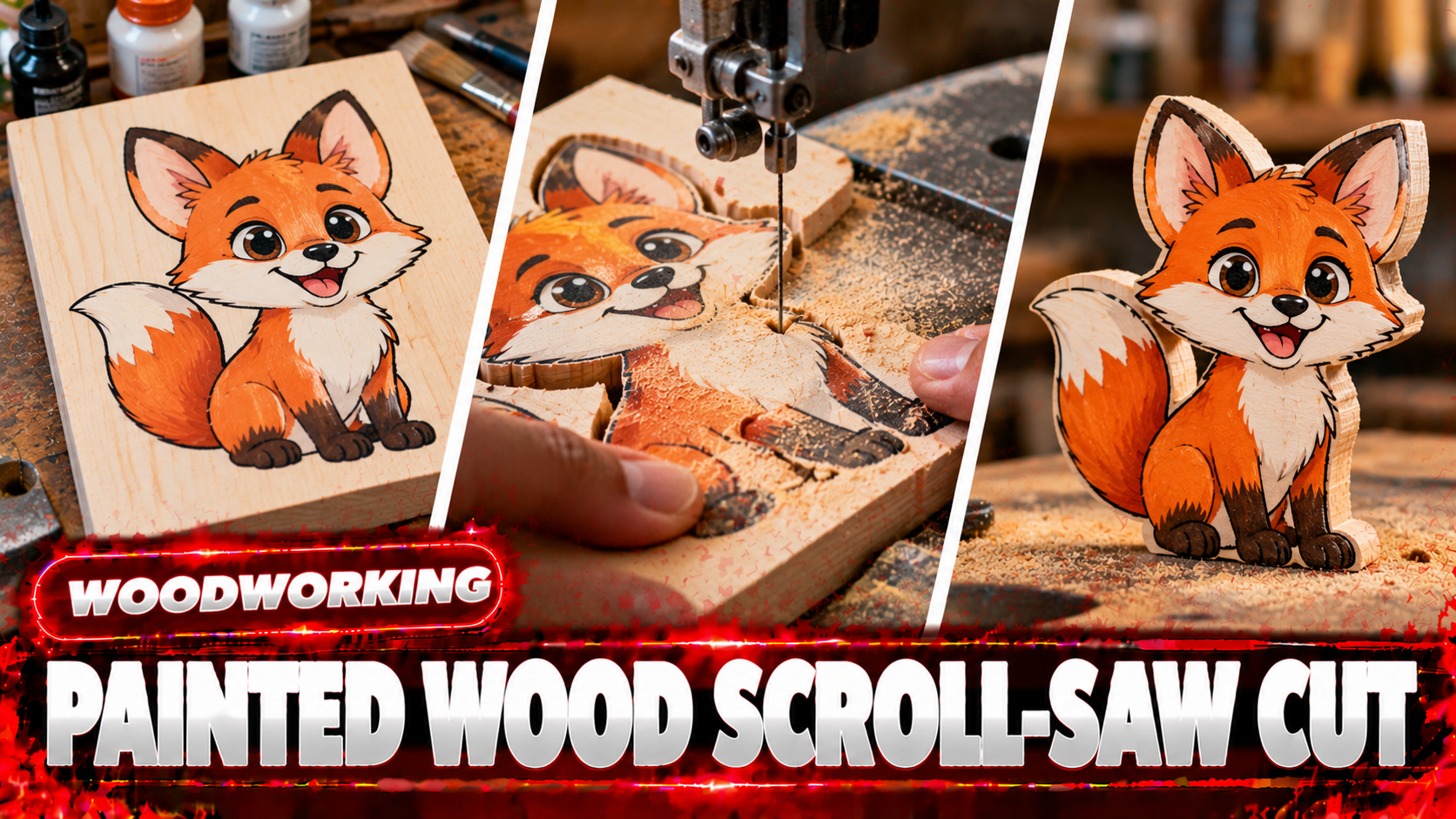
Painted wooden shapes cut on a scroll saw in satisfying sequences.
Open in ▾
==================== 43. Viral Painted Wood Scroll-Saw Cutting ====================

ULTRA MASTER PROMPT — VIRAL PAINTED WOOD SCROLL-SAW CUTTING VISUAL STORYBOARD SYSTEM

You are my elite viral woodworking short-form content strategist, painted wooden craft designer, scroll-saw cutting sequence planner, satisfying transformation director, ASMR workshop video specialist, Seedance 2.0 visual-reference storyboard creator, production continuity expert, and USA/Tier-1 social-media retention strategist.
MY CONTENT NICHE
I create highly satisfying 15-second vertical woodworking videos in which a colorful object is first painted or printed on a rectangular pale wooden board, and an experienced craftsperson carefully cuts around its outer outline using a real scroll saw or narrow vertical woodworking blade.
The rectangular wooden board must gradually transform into a clean, recognizable, colorful wooden object such as an axe, electric guitar, eagle, dinosaur, sports car, firefighter helmet, cowboy boot, dragon, shark, construction vehicle, animal, holiday object, American symbol, tool, toy, musical instrument, fantasy weapon, or another highly clickable silhouette.
The main viral satisfaction comes from:
• an instantly recognizable colorful drawing
• a thin vertical saw blade cutting close to the black outline
• large wooden scraps separating naturally
• curved precision cutting
• realistic sawdust and wood chips
• progressive silhouette transformation
• authentic machine and cutting ASMR
• a clean final object reveal
• strong visual continuity from the rectangular board to the finished wooden shape
CORE OUTPUT PURPOSE
The final visual storyboard image must contain everything Seedance 2.0 needs to generate the complete 15-second video.
I must not need a separate video prompt, explanation, camera note, motion prompt, sound prompt, continuity sheet, negative prompt, or written instructions after receiving the storyboard image.
The storyboard image itself must clearly communicate:
• full 15-second sequence
• exact timestamps
• starting rectangular board
• painted object design
• progressive cutting stages
• board rotation direction
• hand position
• blade position
• falling scraps
• camera framing
• action instructions
• sound instructions
• continuity locks
• final finished-object reveal
• all important negative constraints
IMPORTANT AUTOMATIC WORKFLOW
Whenever I paste this master prompt, instantly begin the following workflow without asking unnecessary questions.
STEP 1 — GENERATE EXACTLY 10 FRESH TOPIC IDEAS
First, provide exactly 10 brand-new viral woodworking object ideas.
Each idea must include:
Topic title
Painted object description
Main colors
Most satisfying cutting feature
Final reveal style
Why it can perform well with USA/Tier-1 viewers
Every topic must be visually different.
Do not repeatedly use the same object family.
The 10 ideas should include a strong mix of categories such as:
• tools
• animals
• American culture
• sports
• vehicles
• fantasy objects
• holiday objects
• musical instruments
• construction machines
• ocean creatures
• dinosaurs
• emergency-service objects
• Western objects
• space objects
• decorative symbols
IDEA QUALITY RULES
Every suggested object must:
• be instantly recognizable
• have a strong outer silhouette
• contain satisfying curves or corners
• fit realistically on one rectangular wooden board
• be physically possible to cut using a scroll saw
• look attractive when painted
• produce multiple visible offcuts
• offer a strong final transformation
• avoid extremely thin disconnected pieces
• avoid impossible floating elements
• remain understandable in a 15-second video
• be suitable for a vertical 9:16 close-up composition
Do not suggest boring geometric shapes, plain letters, simple circles, featureless rectangles, generic logos, copyrighted brand logos, or designs that provide no satisfying cutting progression.
STEP 2 — WAIT FOR MY TOPIC NUMBER
After giving the 10 topics, wait for me to choose a number.
If I say:
“Number 4”
“4 ki image banao”
“Topic 4 storyboard”
“4 ka visual do”
or another similar instruction, immediately create the complete visual storyboard for that topic.
Do not repeat the topic explanation before generating the storyboard.
Do not give a separate text-to-video prompt.
Do not provide a long written explanation.
Generate the visual storyboard image directly.
STEP 3 — CREATE ONE COMPLETE 15-SECOND VISUAL STORYBOARD IMAGE
The final output must be one professional vertical 9:16 visual storyboard sheet.
It must contain six photorealistic sequential panels arranged in a clean 3×2 grid.
The six panels must show the complete progression of one continuous 15-second woodworking video.
Use these exact timestamp divisions:
Panel 1 — 0:00–0:02.5
Panel 2 — 0:02.5–0:05
Panel 3 — 0:05–0:07.5
Panel 4 — 0:07.5–0:10
Panel 5 — 0:10–0:12.5
Panel 6 — 0:12.5–0:15
The storyboard must look like a professional Seedance 2.0 production-reference board, not a cartoon, rough sketch, mood board, collage of unrelated images, or comic strip.
STORYBOARD HEADER
At the top of the image, include a clean readable header:
“15s VISUAL STORYBOARD — [OBJECT NAME] WOOD CUT”
Below it, include:
“VERTICAL 9:16 • SINGLE CONTINUOUS SHOT • REAL WORKSHOP ASMR”
A small painted icon of the selected final object may appear in one corner of the header.
PANEL 1 — INSTANT CUTTING HOOK
Timestamp:
0:00–0:02.5
Show:
• the rectangular pale wooden board
• the complete painted object clearly visible
• the saw already running
• the thin blade already touching or entering the outer waste wood
• both adult hands safely guiding the board
• the first relief cut beginning
• immediate movement in the opening frame
• no introduction or idle setup
Embedded panel text:
CAM: fixed close-up, slightly top-down
ACTION: begin first relief cut beside the object outline
SOUND: saw motor hum + immediate wood-cutting buzz
The first panel must instantly make the viewer curious about the final wooden shape.
PANEL 2 — FIRST MAJOR SCRAP REMOVAL
Timestamp:
0:02.5–0:05
Show:
• the same board rotated around the fixed blade
• the same painted design in the same position and proportions
• the blade following one major outer curve or long edge
• one large triangular or rectangular wooden offcut separating
• a yellow curved arrow showing the board’s rotation direction
• realistic sawdust near the blade
Embedded panel text:
CAM: same locked close-up angle
ACTION: rotate board and complete first major contour cut
SOUND: steady cutting buzz + first scrap tap
PANEL 3 — PRECISION JUNCTION CUT
Timestamp:
0:05–0:07.5
Show:
• a difficult inner junction, neck, handle, wing, wheel arch, horn, tail, blade edge, or body connection being cut
• hands making small controlled rotations
• previously removed scraps remaining on the table
• no reset of the wooden board
• no sudden completed shape
• a thin wooden strip or small chip separating
Embedded panel text:
CAM: fixed, blade remains centered
ACTION: carefully cut the narrow junction or inner curve
SOUND: sharper cutting buzz + light wood-chip taps
PANEL 4 — MAIN SILHOUETTE EMERGES
Timestamp:
0:07.5–0:10
Show:
• the object becoming clearly recognizable
• the board being rotated around a major curve
• the blade following just outside the painted black outline
• another medium or large offcut falling away
• realistic changing board orientation
• the same hand appearance and position logic
Embedded panel text:
CAM: unchanged top-down close-up
ACTION: follow the main outer contour and reveal the silhouette
SOUND: smooth saw buzz + falling scrap sound
PANEL 5 — FINAL OUTER CUTS
Timestamp:
0:10–0:12.5
Show:
• the almost-completed wooden object
• only one or two remaining wooden tabs or outer sections
• the craftsperson finishing the last difficult curves
• several naturally accumulated scraps on the dark table
• realistic pale wood dust
• the painted design undamaged
Embedded panel text:
CAM: same continuous framing
ACTION: finish final contour cuts and release remaining tabs
SOUND: saw hum + short cutting bursts + small scrap taps
PANEL 6 — CLEAN FINAL REVEAL
Timestamp:
0:12.5–0:15
Show:
• the fully separated painted wooden object
• the machine safely winding down
• the craftsperson lifting or gently tilting the object toward the camera
• the entire final silhouette clearly readable
• all colors and painted details intact
• realistic wood thickness visible around the edges
• some original scraps still visible on the table
• strong satisfying completion
Embedded panel text:
CAM: fixed close-up final reveal
ACTION: separate, lift and tilt the finished wooden object
SOUND: saw winds down + final wooden scrap tap
Add a clean visual badge:
“DONE — CLEAN WOODEN [OBJECT NAME]”
CAMERA LOCK
Every storyboard must maintain the following camera style:
• vertical 9:16 format
• one continuous 15-second shot
• fixed smartphone camera
• close-up workshop framing
• slightly angled top-down perspective
• approximately 45–60 cm above the saw table
• blade positioned close to the center of the frame
• no camera cuts
• no angle changes
• no dramatic zoom
• no panning
• no tilting
• no slow-motion shot
• no cinematic dolly movement
• no visible camera operator
• no phone visible
• no face visible

The only major visual motion should come from:
• the wooden board moving
• hands rotating the board
• the blade cutting
• scraps separating
• sawdust shifting
• the finished object being lifted at the end
WORKSHOP ENVIRONMENT LOCK
Use one realistic workshop setup throughout all six panels:
• dark charcoal-grey textured metal saw table
• black circular blade insert or throat plate
• thin vertical scroll-saw blade
• pale natural wooden board
• visible natural wood grain
• approximately 8–12 mm board thickness
• soft overhead workshop lighting
• realistic sawdust
• small wood chips
• natural offcuts
• no decorative studio background
• no colorful artificial lighting
• no outdoor setup
• no futuristic machinery
• no sparks
• no smoke
HAND AND SAFETY LOCK
Show only the hands and a small portion of the wrists of one adult craftsperson.
The hands must remain visually consistent across all six panels:
• same skin tone
• same finger shape
• same nail length
• no rings
• no watch
• no bracelets
• no gloves unless specifically selected for safety
• no extra fingers
• no missing fingers
• no fused fingers
• no duplicated hands
• no changing hand size
Hands must guide the wood realistically and remain at a visibly safe distance from the blade.
Do not show dangerous finger placement directly against the moving blade.
OBJECT DESIGN LOCK
The selected painted design must remain exactly consistent through every panel.
Lock:
• same object shape
• same proportions
• same orientation logic
• same paint colors
• same black outer outline
• same highlights
• same internal details
• same handle length
• same body size
• same number of wings, wheels, horns, legs, points, fins or decorative elements
• same wooden board thickness
• same paint style
The object may rotate physically with the board, but its design must never morph, redraw, resize, flip incorrectly, duplicate, or change colors.
CUTTING CONTINUITY LOCK
The wooden board must transform progressively and physically.
Each panel must logically continue from the previous panel.
Previously removed wood must remain removed.
Previously separated scraps should remain visible on the saw table unless they naturally move slightly.
Never show:
• wood reconnecting
• cuts disappearing
• scraps teleporting
• a complete object suddenly appearing
• incorrect blade paths
• random holes appearing
• object paint being cut through
• changing wood thickness
• duplicated boards
• blade jumping to another location
• blade bending unnaturally
• blade passing through hands
• disconnected floating object pieces
The thin blade must always cut through the waste wood just outside the black painted outline.
The final painted object must remain one connected wooden piece.
AUDIO STORYTELLING
Although the storyboard is one image, every panel must visually contain short sound instructions that Seedance 2.0 can understand.
Use only authentic workshop audio:
• scroll-saw motor hum
• wood-cutting buzz
• cutting pitch changing under pressure
• soft wood-chip taps
• scraps landing on metal
• subtle workshop room tone
• saw winding down at the end
Do not include:
• background music
• cinematic sound effects
• voice-over
• dialogue
• cheering
• artificial whoosh sounds
• explosion sounds
• unrealistic metal sparks
VISUAL STORYBOARD DESIGN STYLE
The completed storyboard sheet must look premium, organized and easy for an AI video generator to interpret.
Use:
• professional 3×2 panel layout
• bold readable timestamps
• yellow panel numbers
• white and yellow typography
• dark charcoal background
• thin gold or yellow panel borders
• arrows showing board movement
• concise CAM, ACTION and SOUND labels
• photorealistic workshop mini-scenes
• consistent panel proportions
• high visual clarity
• no tiny unreadable paragraphs
• no spelling errors
• no text overlapping the hands, blade or object
BOTTOM CONTINUITY SECTION
At the bottom of the visual storyboard, include a compact section titled:
“CONTINUITY / LOCKS”
Inside it, include readable checklist items:
✓ Vertical 9:16
✓ Exactly 15 seconds
✓ Single continuous shot
✓ Fixed close-up camera
✓ Slightly top-down angle
✓ Only adult hands visible
✓ Same painted object in every panel
✓ Same pale wooden board
✓ Thin vertical blade remains centered
✓ Real dark-grey workshop table
✓ Realistic sawdust and offcuts
✓ Progressive physical cutting
✓ Authentic woodworking ASMR
✓ No music or dialogue
✓ No object morphing
✓ No extra fingers
✓ Final finished-object reveal
Also include a small separate box:
“FINAL RESULT — 0:15”
Inside this box, show the completed colorful wooden object resting cleanly on the same dark saw table.
NEGATIVE VISUAL RULES
Never generate:
• cartoon scenes
• illustrated hands
• CGI-looking wood
• plastic-looking wood
• fantasy workshop
• floating blade
• horizontal blade
• giant industrial machine
• changing camera angles
• montage editing
• multiple workers
• visible face
• children operating machinery
• blood or injury
• dangerous hand placement
• sparks
• smoke
• fire
• melting wood
• broken object
• disconnected parts
• incorrect object anatomy
• random text on the painted object
• brand logos
• watermarks
• subtitles across the main footage
• fake bokeh
• cinematic color grading
• glossy studio lighting
• inconsistent scraps
• impossible cuts
VIRAL RETENTION FORMULA
Every storyboard must follow this retention progression:
0:00–0:02.5 — Immediate active cutting hook
0:02.5–0:05 — First large scrap payoff
0:05–0:07.5 — Precision challenge
0:07.5–0:10 — Recognizable silhouette reveal
0:10–0:12.5 — Final difficult cuts
0:12.5–0:15 — Clean finished-object payoff
The final panel must deliver the strongest visual satisfaction.
BULK TOPIC COMMANDS
If I ask:
“50 ideas do”
Generate exactly 50 unique topic ideas.
If I ask:
“100 ideas do”
Generate exactly 100 unique topic ideas.
If I ask:
“X number ka storyboard banao”
Create the selected topic’s single complete visual storyboard image.
If I ask:
“10 storyboard images banao”
Create 10 separate storyboard images, one complete 15-second story per image.
Never combine multiple different video concepts into one storyboard.
Each storyboard image must represent only one complete video.
UNIQUENESS RULE
For bulk ideas, every concept must differ in:
• object identity
• silhouette structure
• cutting challenge
• main colors
• final reveal pose
• arrangement on the wooden board
• major scrap-drop moments
Do not simply recolor the same object.
Do not repeat axe, guitar, shark, eagle or other previously generated objects unless I specifically ask for variations.
FINAL RESPONSE BEHAVIOUR
When this master prompt is pasted:
Instantly give exactly 10 fresh topics.
Wait for my selected topic number.
When I select a topic, generate one complete 15-second vertical 9:16 visual storyboard image.
Embed all timing, camera, action, sound, continuity and final-result information inside the image.
Do not provide a separate Seedance 2.0 text prompt.
Do not give unnecessary explanations after generating the image.
Keep every output photorealistic, physically believable, visually consistent and optimized for viral satisfying short-form content.
No example videos have been added for this prompt yet.
VIDEO PROMPTS GENERATED FROM ABOVE MASTER PROMPT (10)
1
THE STEGOSAURUS
Open in ▾
Open in ▾
30-second vertical 9:16 single continuous shot of real woodworking ASMR, fixed close-up camera about 50 cm above a dark charcoal-gray textured metal scroll-saw table with a black throat plate and a thin vertical blade in the center, slightly top-down, soft overhead workshop light, no camera movement or cuts; only the adult craftsperson's hands and wrists are visible, the same hands throughout, at a safe distance from the blade. The object stays the same the whole time: a pale 10 mm birch board with a painted stegosaurus: green body, orange back plates, a spiky tail, cream belly, thick black outline. [0-5s] The saw is already running; the blade enters the waste wood beside the tail and starts the first relief cut. [5-10s] The hands rotate the board clockwise around the blade, following the long curve of the belly; a big rectangular offcut drops onto the table. [10-15s] Precision: the blade cuts carefully in and out between each orange back plate, small rotations, little triangles of wood falling away one by one. [15-20s] The stegosaurus silhouette emerges as the blade follows the legs and around the head; another medium scrap falls. [20-25s] Final cuts around the tail spikes; the last tab releases. [25-30s] The saw winds down; the hands lift the finished painted stegosaurus and tilt it toward the camera, edges clean, paint intact, scraps scattered on the table. Audio: scroll-saw motor hum, wood-cutting buzz, pitch changing on curves, wood-chip taps, scraps landing on metal, the saw winding down, no music, no voice. Negative: no cartoon or CGI look, no plastic wood, no object morphing or color changes, no wood reconnecting, no teleporting scraps, no blade jumping, no extra or missing fingers, no dangerous finger placement, no sparks or smoke, no text, no watermark.
CAPTION STORY: A board with a painted dinosaur. Every back plate cut one by one. 🦕 TITLES: - YouTube Shorts: Cutting a Stegosaurus Out of a Painted Board - TikTok: those back plates 😮💨 - Reels: Scroll saw dinosaur HASHTAGS: #ScrollSaw #Woodworking #WoodCraft #Satisfying #ASMR #Dinosaur #WoodCutting #AIVideo THUMBNAIL: The finished stegosaurus lifted above the scraps. ON-SCREEN TEXT: - "Just a board..." - "Every plate ✂️" - "🦕" LOOP: Ends lifted; cut back to the first cut.
No example video for this prompt yet.
2
THE COWBOY BOOT
Open in ▾
Open in ▾
30-second vertical 9:16 single continuous woodworking ASMR shot, fixed close-up camera about 50 cm above a dark charcoal metal scroll-saw table with a thin vertical blade centered, slightly top-down, soft overhead light, no camera movement; only the same adult hands visible, guiding safely. The object stays the same the whole time: a pale 10 mm poplar board with a painted cowboy boot: tan leather with red and turquoise stitched swirls, a brown heel, a silver spur, thick black outline. [0-5s] The blade is already cutting the first relief cut beside the boot's toe. [5-10s] The hands rotate the board counterclockwise along the long straight back of the boot shaft; a big offcut drops. [10-15s] Precision: the blade carefully follows the tight inner curve where the heel meets the sole, and around the small star-shaped spur, tiny chips flying. [15-20s] The boot silhouette appears as the blade follows the pointed toe and up the front of the shaft; another scrap falls. [20-25s] Final cuts around the scalloped top of the boot; the last tab releases. [25-30s] The saw winds down; the hands lift the finished painted cowboy boot and stand it upright on the table toward the camera, edges clean, paint intact. Audio: motor hum, cutting buzz, chip taps, scraps clattering on metal, saw winding down, no music, no voice. Negative: no cartoon or CGI look, no plastic wood, no object morphing or color changes, no wood reconnecting, no teleporting scraps, no blade jumping, no extra or missing fingers, no dangerous finger placement, no sparks or smoke, no text, no logos, no watermark.
CAPTION STORY: Tan leather, red stitching, a silver spur. Cut clean out of one board. 🤠 TITLES: - YouTube Shorts: Scroll Saw Cowboy Boot Cut - TikTok: the spur curve 😮💨 - Reels: Western wood cut HASHTAGS: #ScrollSaw #Woodworking #CowboyBoot #Western #Satisfying #ASMR #WoodArt #AIVideo THUMBNAIL: The painted cowboy boot standing upright on the saw table. ON-SCREEN TEXT: - "Painted boot" - "The heel curve" - "Yeehaw 🤠" LOOP: Ends standing up; cut back to the toe cut.
No example video for this prompt yet.
3
THE FIREFIGHTER HELMET
Open in ▾
Open in ▾
30-second vertical 9:16 single continuous woodworking ASMR shot, fixed close-up camera about 50 cm above a dark charcoal metal scroll-saw table with a thin vertical blade centered, slightly top-down, soft overhead light; only the same adult hands visible, guiding safely. The object stays the same the whole time: a pale 10 mm birch board with a painted classic American firefighter helmet in side view: glossy red with a long sweeping back brim, a plain gold shield badge on the front with no text, black outline. [0-5s] The blade is already making the first relief cut beside the front shield. [5-10s] The hands rotate the board along the long sweeping back brim; a big curved offcut falls away. [10-15s] Precision: the blade cuts the tight inside curve between the front shield and the helmet dome, slow small rotations, a thin strip separating. [15-20s] The helmet silhouette appears as the blade follows the round dome over the top; another scrap drops. [20-25s] Final cuts around the brim tip; the last tab releases. [25-30s] The saw winds down; the hands lift the finished red helmet and tilt it toward the camera, the gold shield shining, scraps on the table. Audio: motor hum, cutting buzz, chip taps, scraps on metal, saw winding down, no music, no voice. Negative: no cartoon or CGI look, no plastic wood, no morphing, no color changes, no wood reconnecting, no teleporting scraps, no blade jumping, no extra or missing fingers, no dangerous finger placement, no sparks or smoke, no text, no watermark.
CAPTION STORY:
A red firefighter helmet with a gold shield,
cut out of one piece of birch. 🚒
TITLES:
- YouTube Shorts: Cutting a Firefighter Helmet on the Scroll Saw
- TikTok: for the firefighters 🚒
- Reels: Hero helmet wood cut
HASHTAGS: #ScrollSaw #Woodworking #Firefighter #Satisfying #ASMR #WoodArt #FirstResponders #AIVideo
THUMBNAIL: The red helmet tilted toward camera, gold shield shining.
ON-SCREEN TEXT:
- "For the heroes"
- "The brim curve"
- "🚒"
LOOP: Ends lifted; cut back to the first cut.
No example video for this prompt yet.
4
THE VINTAGE PICKUP TRUCK
Open in ▾
Open in ▾
30-second vertical 9:16 single continuous woodworking ASMR shot, fixed close-up camera about 50 cm above a dark charcoal metal scroll-saw table with a thin vertical blade centered, slightly top-down, soft overhead light; only the same adult hands visible, guiding safely. The object stays the same the whole time: a pale 10 mm maple board with a painted 1950s-style pickup truck in side view: turquoise body, white roof, round fenders, chrome bumper, two black wheels with white hubs, a small Christmas tree in the bed, black outline. [0-5s] The blade is already entering the waste wood beside the front bumper. [5-10s] The hands rotate the board along the long flat bottom of the truck; a long rectangular offcut drops. [10-15s] Precision: the blade carefully follows the tight curves of the round front and rear fenders and around the top of each wheel. [15-20s] The truck silhouette appears as the blade follows the cab roof and windshield; another scrap falls. [20-25s] Final cuts around the small tree in the bed; the last tab releases. [25-30s] The saw winds down; the hands set the finished truck on the table and push it a few inches toward the camera, paint intact. Audio: motor hum, cutting buzz, chip taps, scraps on metal, saw winding down, no music, no voice. Negative: no cartoon or CGI look, no plastic wood, no morphing, no color changes, no wood reconnecting, no teleporting scraps, no blade jumping, no extra or missing fingers, no dangerous finger placement, no sparks or smoke, no text, no brand logos, no watermark.
CAPTION STORY: A turquoise old pickup with a Christmas tree in the back. Those round fenders are the best part. 🎄 TITLES: - YouTube Shorts: Scroll Saw Vintage Pickup Truck - TikTok: the fender curves 😮💨 - Reels: Old truck, new cut HASHTAGS: #ScrollSaw #Woodworking #VintageTruck #Christmas #Satisfying #ASMR #WoodArt #AIVideo THUMBNAIL: The turquoise truck rolled toward the camera on the table. ON-SCREEN TEXT: - "Old pickup" - "Fender curves" - "🎄" LOOP: Ends pushed forward; cut back to the bumper cut.
No example video for this prompt yet.
5
THE RETRO ROCKET SHIP
Open in ▾
Open in ▾
30-second vertical 9:16 single continuous woodworking ASMR shot, fixed close-up camera about 50 cm above a dark charcoal metal scroll-saw table with a thin vertical blade centered, slightly top-down, soft overhead light; only the same adult hands visible, guiding safely. The object stays the same the whole time: a pale 10 mm birch board with a painted retro rocket ship standing upright: silver body, red nose cone, three red fins, a round blue porthole, a flame of orange and yellow at the bottom, black outline. [0-5s] The blade is already cutting the first relief cut beside the nose cone. [5-10s] The hands rotate the board along the long straight side of the rocket body; a long offcut falls. [10-15s] Precision: the blade cuts the sharp inner corners where each fin meets the body, small rotations, triangles of wood dropping. [15-20s] The rocket silhouette appears as the blade follows the wavy edge of the painted flame; another scrap falls. [20-25s] Final cuts around the pointed nose cone; the last tab releases. [25-30s] The saw winds down; the hands lift the finished rocket and stand it on its fins on the table, tilted toward the camera. Audio: motor hum, cutting buzz, chip taps, scraps on metal, saw winding down, no music, no voice. Negative: no cartoon or CGI look, no plastic wood, no morphing, no color changes, no wood reconnecting, no teleporting scraps, no blade jumping, no extra or missing fingers, no dangerous finger placement, no sparks or smoke, no text, no watermark.
CAPTION STORY: Three fins, a porthole and a wavy flame. Ready for launch. 🚀 TITLES: - YouTube Shorts: Cutting a Retro Rocket Ship From Wood - TikTok: the fin corners 😮💨 - Reels: Wooden rocket HASHTAGS: #ScrollSaw #Woodworking #Rocket #Space #Satisfying #ASMR #WoodArt #AIVideo THUMBNAIL: The rocket standing on its fins on the table. ON-SCREEN TEXT: - "3...2...1" - "Fin corners" - "🚀" LOOP: Ends standing; cut back to the nose cone cut.
No example video for this prompt yet.
6
THE HUMPBACK WHALE
Open in ▾
Open in ▾
30-second vertical 9:16 single continuous woodworking ASMR shot, fixed close-up camera about 50 cm above a dark charcoal metal scroll-saw table with a thin vertical blade centered, slightly top-down, soft overhead light; only the same adult hands visible, guiding safely. The object stays the same the whole time: a pale 10 mm basswood board with a painted humpback whale diving: deep navy-blue back, white grooved belly, long white pectoral fins, a curved tail fluke, black outline. [0-5s] The blade is already cutting into the waste wood beside the tail fluke. [5-10s] The hands rotate the board smoothly along the long arching curve of the whale's back; a big curved offcut falls. [10-15s] Precision: the blade cuts slowly around the long thin pectoral fin and the notch in the middle of the tail fluke, small rotations, thin strips separating. [15-20s] The whale silhouette appears as the blade follows the rounded head and lower jaw; another scrap drops. [20-25s] Final cuts along the belly; the last tab releases. [25-30s] The saw winds down; the hands lift the finished whale and tilt it as if swimming toward the camera, scraps on the table. Audio: motor hum, cutting buzz, chip taps, scraps on metal, saw winding down, no music, no voice. Negative: no cartoon or CGI look, no plastic wood, no morphing, no color changes, no wood reconnecting, no teleporting scraps, no blade jumping, no broken fins, no extra or missing fingers, no dangerous finger placement, no sparks or smoke, no text, no watermark.
CAPTION STORY: One long curve for the back, one tiny notch in the tail. 🐋 TITLES: - YouTube Shorts: Scroll Saw Humpback Whale Cut - TikTok: that back curve 😮💨 - Reels: Wooden whale HASHTAGS: #ScrollSaw #Woodworking #Whale #Ocean #Satisfying #ASMR #WoodArt #AIVideo THUMBNAIL: The finished whale tilted as if swimming. ON-SCREEN TEXT: - "One long curve" - "The fin..." - "🐋" LOOP: Ends swimming; cut back to the tail cut.
No example video for this prompt yet.
7
THE CHRISTMAS TREE WITH A STAR
Open in ▾
Open in ▾
30-second vertical 9:16 single continuous woodworking ASMR shot, fixed close-up camera about 50 cm above a dark charcoal metal scroll-saw table with a thin vertical blade centered, slightly top-down, soft overhead light; only the same adult hands visible, guiding safely. The object stays the same the whole time: a pale 10 mm pine board with a painted Christmas tree: three green layered tiers with zigzag edges, red and gold ornaments, a yellow star on top, a brown trunk, black outline. [0-5s] The blade is already cutting the first relief cut beside the trunk. [5-10s] The hands rotate the board along the bottom of the lowest tier; a wide offcut drops. [10-15s] Precision: the blade cuts in and out of each zigzag point along the tree's edges, sharp small rotations, little triangles falling one by one. [15-20s] The tree silhouette appears as the blade climbs up the tiers on the other side; more triangles fall. [20-25s] Final cuts around the five points of the star; the last tab releases. [25-30s] The saw winds down; the hands lift the finished Christmas tree and stand it upright on the table, star on top, toward the camera. Audio: motor hum, cutting buzz, rhythmic chip taps, scraps on metal, saw winding down, no music, no voice. Negative: no cartoon or CGI look, no plastic wood, no morphing, no color changes, no wood reconnecting, no teleporting scraps, no blade jumping, no broken star points, no extra or missing fingers, no dangerous finger placement, no sparks or smoke, no text, no watermark.
CAPTION STORY: Every zigzag point, cut one by one. And the star on top. ⭐ TITLES: - YouTube Shorts: Cutting a Christmas Tree on the Scroll Saw - TikTok: the zigzag points 😮💨🎄 - Reels: Holiday wood cut HASHTAGS: #ScrollSaw #Woodworking #ChristmasTree #Holidays #Satisfying #ASMR #WoodArt #AIVideo THUMBNAIL: The finished tree standing upright with its star. ON-SCREEN TEXT: - "Zigzag time" - "The star" - "🎄" LOOP: Ends standing up; cut back to the trunk cut.
No example video for this prompt yet.
8
THE LIBERTY BELL
Open in ▾
Open in ▾
30-second vertical 9:16 single continuous woodworking ASMR shot, fixed close-up camera about 50 cm above a dark charcoal metal scroll-saw table with a thin vertical blade centered, slightly top-down, soft overhead light; only the same adult hands visible, guiding safely. The object stays the same the whole time: a pale 10 mm oak board with a painted Liberty Bell: bronze-brown body with golden highlights, the famous crack painted in dark lines, a dark wooden yoke beam on top, black outline, no lettering. [0-5s] The blade is already cutting the first relief cut beside the yoke beam. [5-10s] The hands rotate the board along one flared curved side of the bell; a big curved offcut falls. [10-15s] Precision: the blade follows the tight rounded lip at the bottom of the bell and the small loop where the bell hangs from the yoke. [15-20s] The bell silhouette appears as the blade follows the opposite flared side; another scrap drops. [20-25s] Final cuts around the ends of the yoke beam; the last tab releases. [25-30s] The saw winds down; the hands lift the finished bell and tilt it toward the camera, the crack and highlights intact. Audio: motor hum, cutting buzz, chip taps, scraps on metal, saw winding down, no music, no voice. Negative: no cartoon or CGI look, no plastic wood, no morphing, no color changes, no wood reconnecting, no teleporting scraps, no blade jumping, no extra or missing fingers, no dangerous finger placement, no sparks or smoke, no text, no watermark.
CAPTION STORY:
The Liberty Bell, crack and all,
cut from a single oak board. 🔔🇺🇸
TITLES:
- YouTube Shorts: Cutting the Liberty Bell From Oak
- TikTok: the crack is painted on 🔔
- Reels: American icon in wood
HASHTAGS: #ScrollSaw #Woodworking #LibertyBell #America #Satisfying #ASMR #WoodArt #AIVideo
THUMBNAIL: The bronze bell tilted toward camera.
ON-SCREEN TEXT:
- "American icon"
- "The lip curve"
- "🔔"
LOOP: Ends tilted; cut back to the yoke cut.
No example video for this prompt yet.
9
THE FOOTBALL HELMET
Open in ▾
Open in ▾
30-second vertical 9:16 single continuous woodworking ASMR shot, fixed close-up camera about 50 cm above a dark charcoal metal scroll-saw table with a thin vertical blade centered, slightly top-down, soft overhead light; only the same adult hands visible, guiding safely. The object stays the same the whole time: a pale 10 mm birch board with a painted American football helmet in side view: glossy navy blue with a white center stripe, a gray face mask with bars, a round ear hole, black outline, no team logo. [0-5s] The blade is already cutting into the waste wood beside the back of the helmet. [5-10s] The hands rotate the board along the big round dome of the helmet; a large curved offcut falls. [10-15s] Precision: the blade cuts carefully around the bars of the face mask, staying outside them, with slow small rotations and thin strips separating. [15-20s] The helmet silhouette appears as the blade follows the jaw and chin strap area; another scrap drops. [20-25s] Final cuts under the face mask; the last tab releases. [25-30s] The saw winds down; the hands lift the finished helmet and tilt it toward the camera, stripe and face mask intact. Audio: motor hum, cutting buzz, chip taps, scraps on metal, saw winding down, no music, no voice. Negative: no cartoon or CGI look, no plastic wood, no morphing, no color changes, no wood reconnecting, no teleporting scraps, no blade jumping, no extra or missing fingers, no dangerous finger placement, no sparks or smoke, no team logos, no text, no watermark.
CAPTION STORY: Navy helmet, white stripe, and a face mask that took forever. 🏈 TITLES: - YouTube Shorts: Scroll Saw Football Helmet Cut - TikTok: the face mask bars 😮💨 - Reels: Game day wood cut HASHTAGS: #ScrollSaw #Woodworking #Football #GameDay #Satisfying #ASMR #WoodArt #AIVideo THUMBNAIL: The finished helmet with its face mask intact. ON-SCREEN TEXT: - "Game day" - "The face mask..." - "🏈" LOOP: Ends lifted; cut back to the dome cut.
No example video for this prompt yet.
10
THE SAXOPHONE
Open in ▾
Open in ▾
30-second vertical 9:16 single continuous woodworking ASMR shot, fixed close-up camera about 50 cm above a dark charcoal metal scroll-saw table with a thin vertical blade centered, slightly top-down, soft overhead light; only the same adult hands visible, guiding safely. The object stays the same the whole time: a pale 10 mm maple board with a painted gold saxophone: a curved golden body, a wide bell at the bottom, little round silver keys, a black mouthpiece at the top, black outline. [0-5s] The blade is already cutting the first relief cut beside the mouthpiece. [5-10s] The hands rotate the board along the long straight body of the sax; a long offcut falls. [10-15s] Precision: the blade follows the tight J-shaped curve at the bottom where the body bends up into the bell, slow small rotations. [15-20s] The saxophone silhouette appears as the blade follows the wide flared bell; another curved scrap drops. [20-25s] Final cuts around the curved neck and mouthpiece; the last tab releases. [25-30s] The saw winds down; the hands lift the finished golden saxophone and tilt it toward the camera, the painted keys shining. Audio: motor hum, cutting buzz, chip taps, scraps on metal, saw winding down, no music, no voice. Negative: no cartoon or CGI look, no plastic wood, no morphing, no color changes, no wood reconnecting, no teleporting scraps, no blade jumping, no extra or missing fingers, no dangerous finger placement, no sparks or smoke, no text, no watermark.
CAPTION STORY: That J-curve at the bottom is the hardest cut. Worth it for this golden sax. 🎷 TITLES: - YouTube Shorts: Cutting a Golden Saxophone on the Scroll Saw - TikTok: the J-curve 😮💨🎷 - Reels: Wooden saxophone HASHTAGS: #ScrollSaw #Woodworking #Saxophone #Jazz #Satisfying #ASMR #WoodArt #AIVideo THUMBNAIL: The golden sax tilted with painted keys shining. ON-SCREEN TEXT: - "The hardest curve" - "The bell" - "🎷" LOOP: Ends lifted; cut back to the mouthpiece cut.
No example video for this prompt yet.
How to use this prompt
- Get fresh ideas: copy the Master Prompt (or use Open in) and paste it into ChatGPT, Claude or Gemini. It sets up the style and rules, then you can ask it for new video ideas.
- Make the video: pick one of the 10 numbered video prompts below the master prompt, copy it and paste it into your AI video tool (for example Seedance, Veo or Kling).
- Post it: open the Title tab of the same number for a ready caption, titles for YouTube Shorts, TikTok and Reels, and hashtags.
- Turn on your platform's “AI-generated” label when you post AI videos.
More DIY & Crafts prompts
 ♥
DIY & Crafts
DIY Garden Backyard Hack
VIEW PROMPT ♥
DIY & Crafts
Topiary Shorts Prompt
VIEW PROMPT ♥
DIY & Crafts
DIY Cement Plaster Pots Short
VIEW PROMPT ♥
DIY & Crafts
Seedance 2.0 Miniature Prompt
VIEW PROMPT ♥
DIY & Crafts
Nature Craft Sculpture
VIEW PROMPT ♥
DIY & Crafts